
)
sovity is certified for Catena-X PCF Standard in Saturn Release! We use this opportunity to demystify the Product Carbon Footprint (PCF) use case.
The Automotive industry is driving its decarbonization towards a sustainable, emission-free product lifecycle. One key pillar is establishing the necessary and mandatory CO₂ / emission transparency as expressed by the Product Carbon Footprint (PCF).
PCF becomes a binding requirement for suppliers: OEMs increasingly reach out to their network to gather emissions data in form of PCFs of automotive parts (recent example given with Ford and its Kuga).
Catena-X connection increasingly becomes a mandatory requirement by OEMs. Early adopters used previous use cases to gain competitive advantages and strengthen their supplier-OEM relationship. With PCF the next Catena-X use case is rolled out on a large scale.
Why PCF is relevant for OEMs and Suppliers?
Global warming and the transformation of the economy towards sustainability is a societal issue targeted by the European Union and across the globe. Consequently, members of the automotive value chain face several legal requirements for example on Product Carbon Footprint, Battery and Product Passports or Sustainability Reporting to comply with globally (e.g. European Battery Passport Legislation, Chinese National PCF System, California SB 253).
Despite regional developments, the global industry keeps driving sustainability of products and reduction of footprints. The focus shifts from industry-average values towards precision and comparability. This is required for companies to e.g. better understand significant emission sources, take effective measures and avoid or reduce CO2-related fees.
Accurate detection and effective reduction can only be achieved with primary and recent data for scope 1, 2, 3 emissions – from raw material extraction to manufacturing, distribution and beyond.
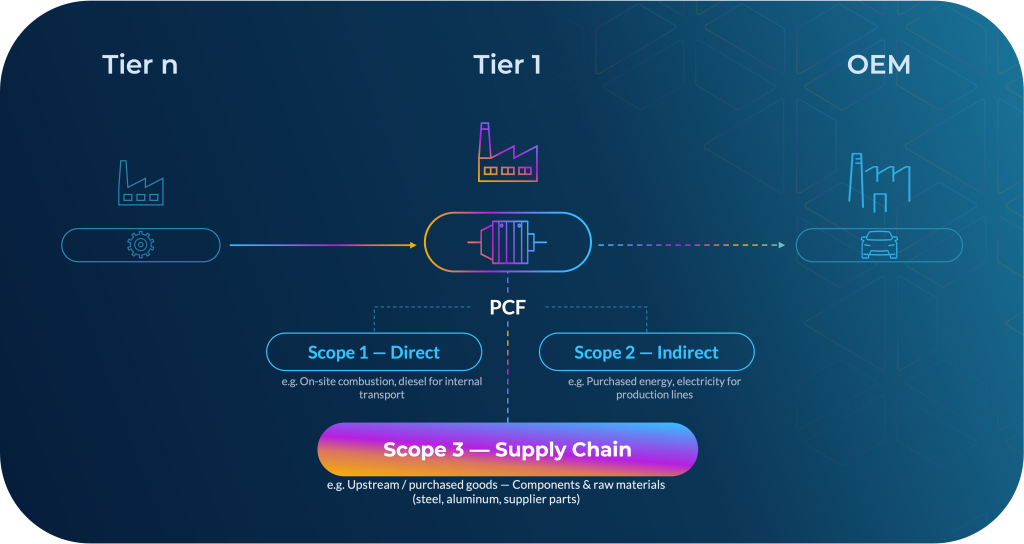
Accurate scope 3 emission data can only be acquired from partners
While scope 1 and 2 emission data are relatively easily accessible for a company on its own, precise scope 3 emissions data can only be acquired from partners. OEMs consequently request accurate, standardized and verifiable scope 3 emissions data of their suppliers.
Especially for rather complex products such as vehicles this is a difficult task: A car easily consists of 20.000+ parts, which are manufactured by 1000+ parties, organized across 5+ tiers, with dozens of manufacturing sites per party around the globe.
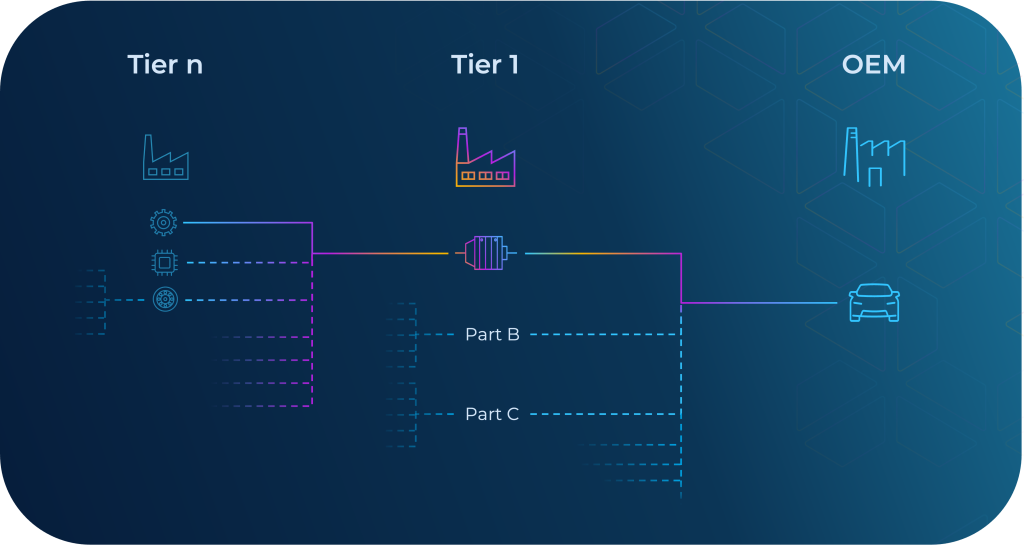
For a complete and precise PCF, data from all members has to be integrated.
Each part and member in the value chain contributes to the overall footprint of a vehicle. An accurate footprint can only be calculated, if the data is combined and calculated in a comparable way. In an economical way this can only be done via automated solutions which are able to automatically aggregate, calculate and provide the relevant data.
When implementing solutions for PCF calculation, companies, and especially automotive suppliers today face difficulties through
A lack of unified calculation methodology
Missing interoperability of tools, interfaces and data formats
Fragmented internal data landscape (MES, ERP, Excel, …)
Existing manual processes to satisfy various (customer) portals, interfaces or formats, resulting in slow, labor-intensive and error‑prone workflows which are not scalable
The framing condition to make existing landscapes fit with new requests
Without intelligent digital tools, PCF can become an operational burden – especially given increasing requests to satisfy not just one, but several customers.
How do Catena-X and sovity facilitate the PCF Use Case?
The automotive network Catena-X shapes secure, interoperable use cases based on live data and joint standards (more on PCF standards below). Catena-X architecture and standards allow to leverage the One-up-One-Down principle to automatically acquire scope 3 emission data from suppliers (upstream), combine them with company internal data (scope 1 and 2 emissions) to calculate accurate Product Carbon Footprints, while also remaining confidentiality and sovereignty on sensitive information.
These PCFs are exchanged between parties via the Catena-X standard interfaces and formats. Parties can use the network for the aggregation of emissions data from not just one (1:1) but multiple suppliers (n:1). Analogous to that, parties can provide PCF data to not only one partner (1:1) but also multiple partners (1:n).
The PCF use case is a prime example of the high scalability in Catena-X, as the effort to acquire and provide data is significantly reduced after
the first product – additional products can be added easily as data formats and integrations are reused
the first supplier – if the connection to one supplier is established, further suppliers can be added quickly for data to be easily acquired
the first customer – satisfying additional partners’ requests at low effort based on the existing setup, as the same interfaces and data models are reused
the first calculation – if the configuration of a new product generation differs or upstream emissions of a product change (e.g. due to improved production processes) the calculation can be iterated based on the existing setup
The extra benefit: once the connection to Catena-X is established and relationship with partners are technically established, this setup can be used to implement further Catena-X use cases at reduced effort.
Due to the Catena-X principles and architecture, companies do not upload their data into a centralized platform but sovereignly decide and control which data is shared with which party via the federated network.
A PCF, however, can only be as accurate as the data it is based on. This requires connecting as many value chain members as possible, to exchange precise and current data. Many members of the value chain do not have the time and budget to become an expert in Catena-X, which can delay or block participation in the use cases.
This is where sovity and Quintari come in. sovity enables companies of all sizes to participate in Catena-X use cases at lowest effort to unleash the inherent value of each use case for themselves. The managed services of the Quintari Suite and sovity’s expertise allow for a fast implementation and return on invest.
To facilitate the participation in the PCF use case, sovity launches Quintari PCF.
What is Quintari PCF?
Quintari PCF is a managed service built specifically for suppliers joining the Catena-X PCF use case.
sovity launches Quintari PCF
sovity Quintari PCF is part of the Quintari suite. Quintari is a suite of easy-to-use managed services which allows for an accelerated Catena-X connection and participation in various use cases without being an expert in Catena-X. With Quintari PCF companies can easily exchange their PCF data with partners.
The solution allows for a
fast onboarding and technical connection to the Catena-X network
easy integration with existing systems and calculator applications
low implementation and maintenance costs via managed services
provision and acquisition of PCF data for an overall facilitated End‑to‑end workflow from data collection, calculation, validation to exchange
and a guided process and consultation for effective implementation
Being the first solution certified for the Catena-X Saturn Release, sovity’s solutions for PCF and other use cases are not just scalable, but also future‑proof (more on certification below).